Listen/Support by visiting inrelativeobscurity.com/shop


Listen/Support by visiting inrelativeobscurity.com/shop

“SILVER DESERT” originally served as the backing track I played improvisational guitar over last Summer in Rhyolite, Nevada for the first iteration of my Nevada Arts Council project grant multimedia project, “In Relative Obscurity (2023)”.
The track consists of cello drones in the key of shifting sand dunes, which resonate in the key of C; which I found reflected the remote location it was captured from.
It was ultimately in conversation with the environment I recorded it in; Calico Basin, as part of my artist in residency experience with the Cube Gallery in 2022. The desert landscape had never struck me as something, or somewhere, worth interacting with; let alone using it almost directly as I can as a medium to create new works. I’m thankful I came upon Goldwell Open Air Museum and it’s sculptures/stories. I look forward to creating more works in dialogue with these subjects.
Field recordings always interested me, but capturing this recording of a cello in such a large, open studio was great. It really let the room lend itself to the overall sound of the final result.
The inclusion of “Silver Desert” in a Deathbed Tapes record label release is a huge win for me, and quite the milestone. I look forward to submitting my works to future opportunities and different record labels.
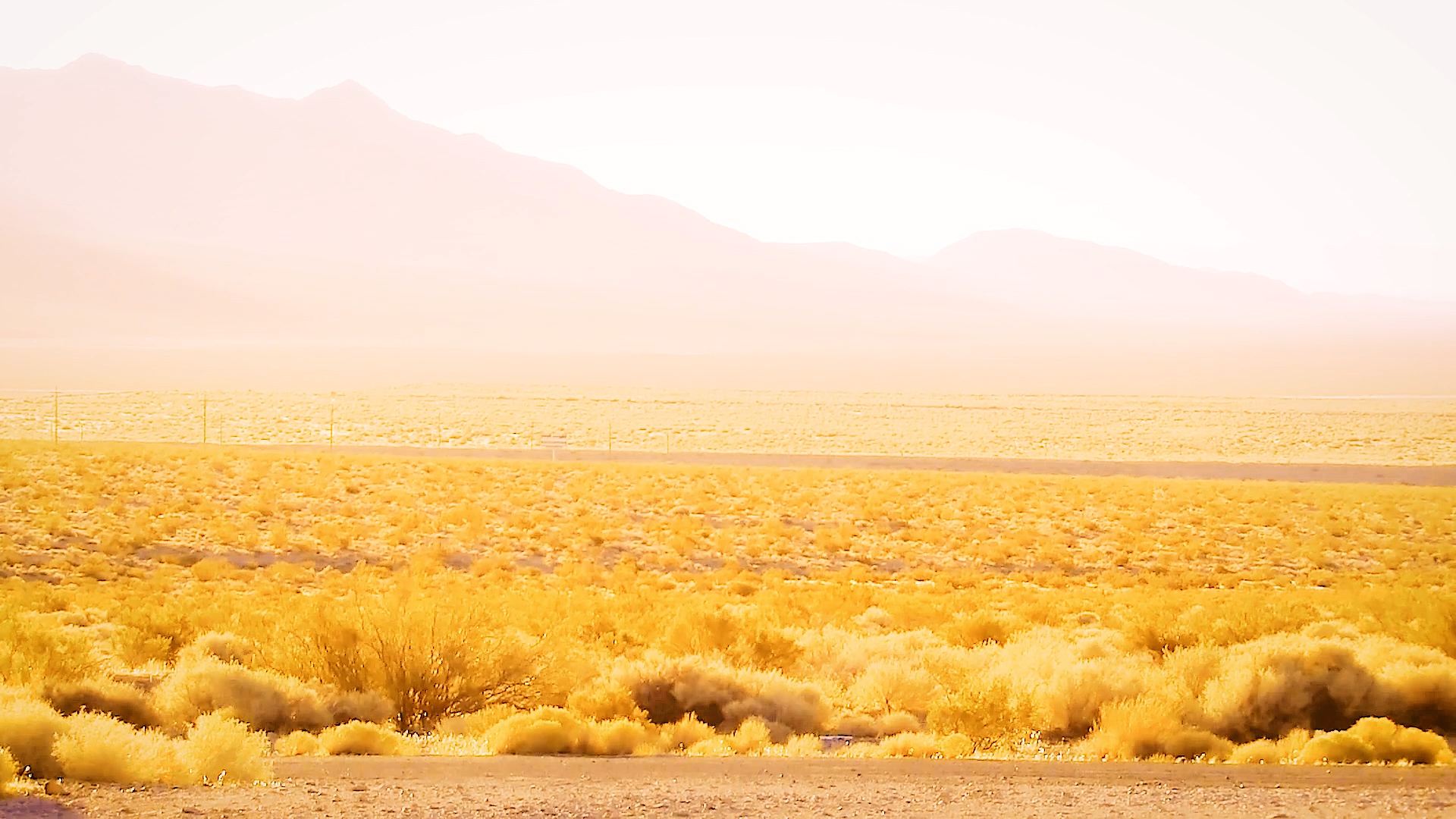
In Relative Obscurity II: Without An End In Mind is an experimental, site-specific audio-visual project that merges improvisational (loosely) American Primitive Guitar with field recordings and video art sourced from the Mojave Desert; more specifically, Rhyolite, Nevada, USA.
The subtitle, Without An End In Mind, is taken directly from an essay I was commissioned to write for the UNLV Marjorie Barrick Museum’s quarterly publication, Dry Heat Vol. 5 (aka “The Goldwell Issue”. I wrote about the first iteration of IRO and how I was inspired by Albert’s spirit of improvisation, in contrast to Executive Director, Suzanne Hackett-Morgan’s opening essay reflecting on the origins of the organization and her vision for it’s future.
The project is conceptually grounded in the legacy of the late Belgian artist Albert Szukalski. It serves as a contemporary dialogue with Szukalski’s methods, while also responding to the desert environment itself, where even the movement of sand produces remarkable ambient sonic textures. He remarked that the landscape of Nevada, specifically Rhyolite, reminded him of the holy lands depicted in the bible; making it the perfect backdrop for his Last Supper sculpture.
Filmed on October 19th, 2024, the morning of Goldwell’s 40th anniversary celebration, the work largely centers on a single static sunrise shot of the valley. The audio consists of an improvised electric guitar performance recorded with an amplifier and field recorder, capturing the violence of the high desert winds and the reverb of my guitar’s sound; both bouncing off of the barn’s metal tin roof.
This project was funded in part by the Nevada Arts Council and the National Endowment for the Arts.

This project was funded in part by the Nevada Arts Council & the National Endowment for the Arts.

You can Listen/Support on Bandcamp or listen on Spotify, etc.


In 1972, founding artist of Goldwell Open Air Museum Albert Szukalski had a solo exhibition at the MultiArt Gallery of Liliane and Paul Ibou in Antwerp, Belgium. At the same time, Szukalski presented two different shows with two different invitations, one pop art, the other one conceptual. For ‘13 self-portraits on an Andy Warhol base’ Szukalski took a silk-screened self-portrait of Warhol and introduced his own self-portrait in it. He performed the result in thirteen different colours in Warhol’s way.
The second part of the exhibition ‘General view on culture (?)’, presented a series of thirteen square mirrors carrying comments such as “General view on culture” or “An innocent onlooker”. Szukalski ironically stated that, with his mirrors he had created both a utility object for the lady and an art object with a deeper thought for the gentleman…

With Adriaan Raemdonck’s gallery De Zwarte Panter in Antwerp, Szukalski established his longest and closest collaboration. The gallery dedicated four solo exhibitions to the artist in the seventies. In 1973 the exhibition ‘Bagage’ presented a series of assemblages of suitcases and a scaled-down version in bronze. Later in the same year, the exhibition ‘Safari’, in collaboration with the fur manufacturer Benoit, showed a series of large-scale collages made of fur. At the vernissage, Szukalski had a model dressed in a panther coat parade with a real panther. In 1975 with the exhibition ‘Perforaties’ Szukalski presented ready-made sculptures and objects in which he had drilled holes. In 1976, for the exhibition ‘Patate cosaque, patate sauvage’ Szukalski made a point of producing the most expens resulting in nine bronze potato sculptures.”– Excerpt from Szukalski, Eenvoudig dus moeilijk, Retrospective Biographical Publication by Verbeke Foundation
I love that we can see Albert go from, honestly, quite a focused though still humorous body of work in conversation with Andy Warhol‘s works at the time straight into De Zwarte Panter. It states his first show was named “Bagage” and it was literally suitcases and various other forms of literal baggage. I can appreciate Adriaan’s allowance of Albert’s forward thinking/improvisational approaches to exhibitions, as that is honestly how great things are done in art. Patronage alone is a vital part of creation, whether it’s by one’s self or an art collector; so Adriaan letting Albert come in and do his thing so seemingly carelessly reads as a refreshing take on “fringe” art practices happening at the time.
This is something Albert often considered in his works; the concept of the moment, intuition, situations. He was called “the situation-maker” by the Antwerp press, a name he proudly kept and one that seemed to fuel his works in the early 70’s, mostly at De Zwarte Panter. Brilliance can be beckoned by simply “letting go” or being mindfully free of any constraints; real or imagined. It can be more difficult than actually planning out ones moves / paintings, sculptures, etc.
I like to think Albert remembered that consistently throughout his years and subconsciously communicated it in his works.
