Tag: sculpture

  • Intangible Beacons of Migration Public Artwork, Spring, 2022

    Intangible Beacons of Migration Public Artwork, Spring, 2022

    2021 was a year of ridiculous success for me.

    It was the year I finally worked out of a legitimate art studio and had 2 different Artist In Residency experiences. Residency experiences are essentially giving someone gallery space to work and/or display their work. For some, it’s an experiment in transition when it comes to the environment they paint in. For others, like me, it’s an experiment in having ANY environment to actually paint in; with your body and soul (as cheesy as that is).

    Having a studio space awarded to me via an application process was a lesson in patience that proved essential when applying these types of opportunities. Each phase of the decision process would include me weeks of waiting in which I would look inwards towards my self and any possible motivations that I could identify that might not be what I consciously believed was happening.


    After a few weeks of reflection & lack of space to paint in at home, it became clear to me I wanted a place outside of my home to create large format abstract expressionist artworks. The point in my life in which I became aware of this was objectively the opposite of a time in which I could afford or even get to an art gallery, let alone work daily on my creative practices in one. Realistically, it seemed a rather long term goal, which I was honestly comfortable with.

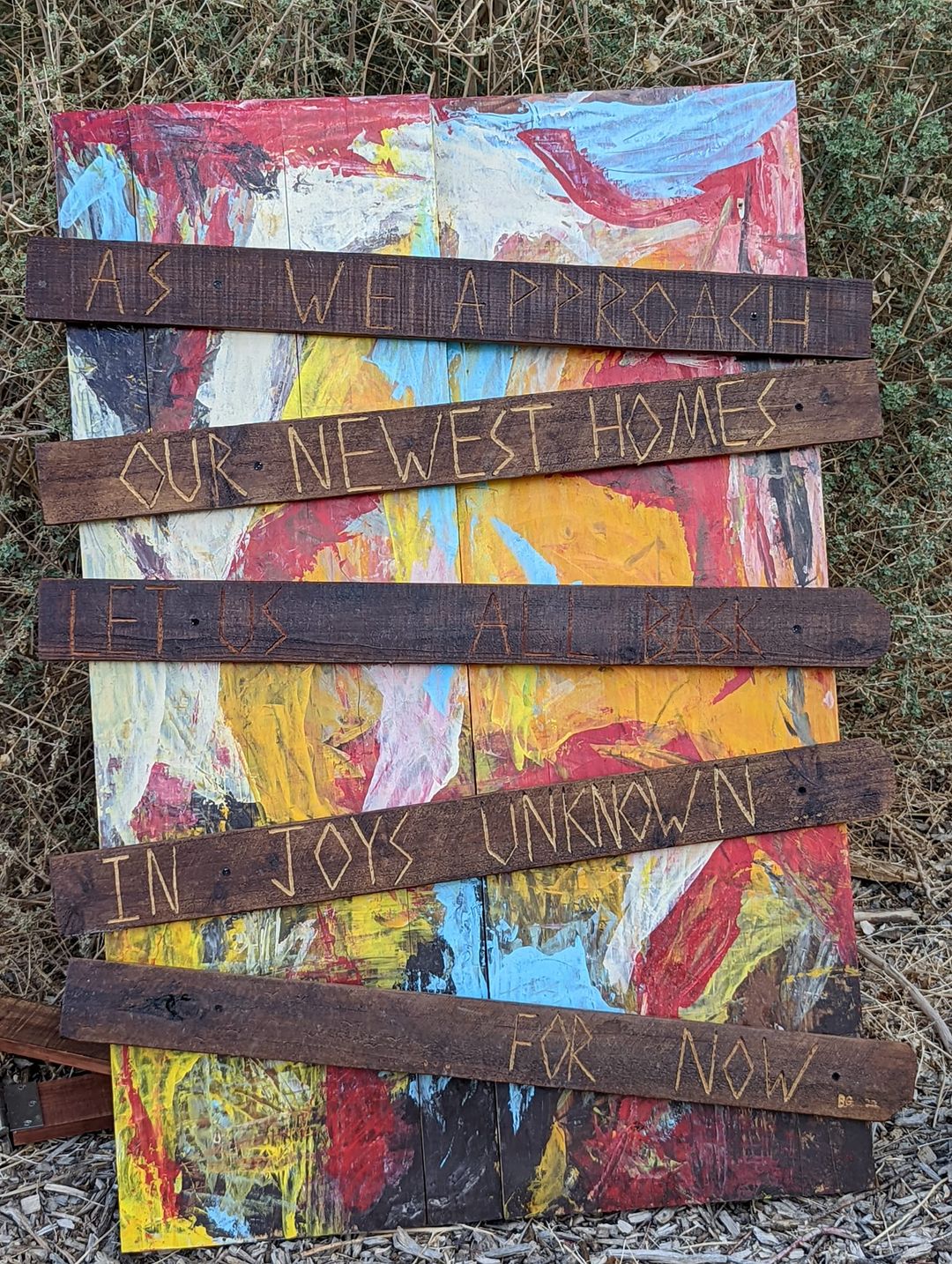
    Painting it of course more that just the act itself, though. This is something that is hard to articulate through words. And thus, after this loose goal was made in my mind in January 2021, I kept living, unknowingly jumping head first into a year that would see me work out of 4 different studio spaces in both New Orleans Square Arts Factory. I would either pay rent or be granted a month or so in which I could paint in a particular space. One of these would be Fremont Country Club, in which I would write the poem shown in the image at the top of this post

    I wrote the poem while I was absolutely pulling my hair out trying to imagine what I should submit as my first public art proposal idea. My mind had originally gone towards sculpture as the best medium to explore for this opportunity to display “site-specific artwork for the Wetlands Park using recycled and earth-friendly materials” that would be essentially be made for the general public.

    In the end I would scrawl this poem into four planks of wood that were screwed into a wooden canvas I had painted for it’s background. I was happy with it, and I was happy to have been successful in my application process as well as carrying it out, from beginning to end.

    Here is where you can find all ten artists that participated in the 2022 public art project, “MIGRATE”.

  • Early Life and Works of Albert Szukalski


    De oorlog is voorbij! (self-portrait on an Andy Warhol base)
    * zeefdruk * 82 x 71 cm * 1972
    collectie Frank Heirman, Antwerpen

    In 1972, founding artist of Goldwell Open Air Museum Albert Szukalski had a solo exhibition at the MultiArt Gallery of Liliane and Paul Ibou in Antwerp, Belgium. At the same time, Szukalski presented two different shows with two different invitations, one pop art, the other one conceptual. For ‘13 self-portraits on an Andy Warhol base’ Szukalski took a silk-screened self-portrait of Warhol and introduced his own self-portrait in it. He performed the result in thirteen different colours in Warhol’s way.


    The second part of the exhibition ‘General view on culture (?)’, presented a series of thirteen square mirrors carrying comments such as “General view on culture” or “An innocent onlooker”. Szukalski ironically stated that, with his mirrors he had created both a utility object for the lady and an art object with a deeper thought for the gentleman…


    General view on culture (?) * spiegels (details) * (x2) 100 x 100 x 13 cm * 1972
    collectie Verbeke Foundation, Kemzeke

    With Adriaan Raemdonck’s gallery De Zwarte Panter in AntwerpSzukalski established his longest and closest collaboration. The gallery dedicated four solo exhibitions to the artist in the seventies. In 1973 the exhibition ‘Bagage’ presented a series of assemblages of suitcases and a scaled-down version in bronze. Later in the same year, the exhibition ‘Safari’, in collaboration with the fur manufacturer Benoit, showed a series of large-scale collages made of fur. At the vernissage, Szukalski had a model dressed in a panther coat parade with a real panther. In 1975 with the exhibition ‘Perforaties’ Szukalski presented ready-made sculptures and objects in which he had drilled holes. In 1976, for the exhibition ‘Patate cosaque, patate sauvage’ Szukalski made a point of producing the most expens resulting in nine bronze potato sculptures.”– Excerpt from Szukalski, Eenvoudig dus moeilijk, Retrospective Biographical Publication by Verbeke Foundation

    I love that we can see Albert go from, honestly, quite a focused though still humorous body of work in conversation with Andy Warhol‘s works at the time straight into De Zwarte Panter. It states his first show was named “Bagage” and it was literally suitcases and various other forms of literal baggage. I can appreciate Adriaan’s allowance of Albert’s forward thinking/improvisational approaches to exhibitions, as that is honestly how great things are done in art. Patronage alone is a vital part of creation, whether it’s by one’s self or an art collector; so Adriaan letting Albert come in and do his thing so seemingly carelessly reads as a refreshing take on “fringe” art practices happening at the time.

    This is something Albert often considered in his works; the concept of the moment, intuition, situations. He was called “the situation-maker” by the Antwerp press, a name he proudly kept and one that seemed to fuel his works in the early 70’s, mostly at De Zwarte Panter. Brilliance can be beckoned by simply “letting go” or being mindfully free of any constraints; real or imagined. It can be more difficult than actually planning out ones moves / paintings, sculptures, etc.

    I like to think Albert remembered that consistently throughout his years and subconsciously communicated it in his works.