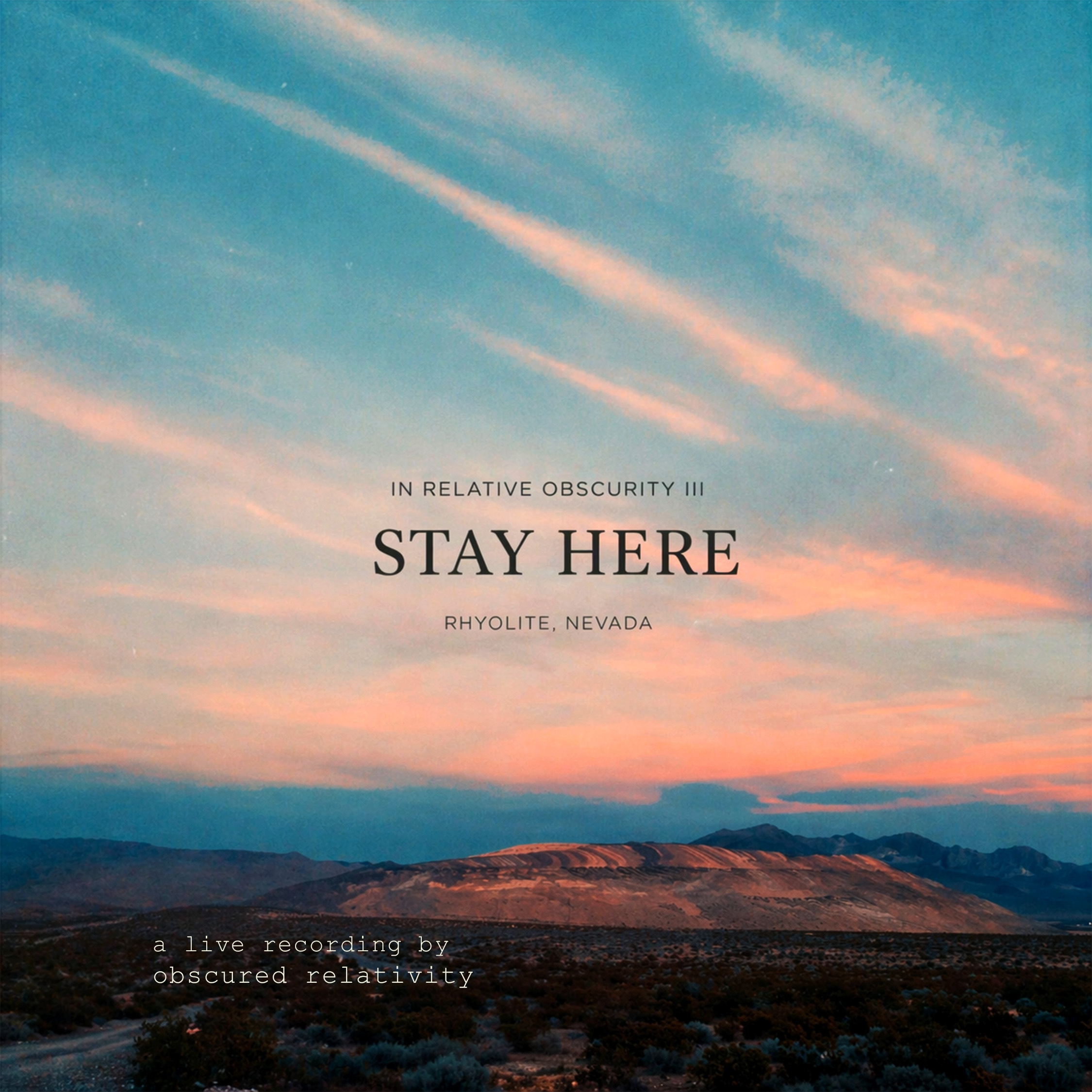
In Relative Obscurity III: Stay Here is a site responsive sound and documentation project centered on a 30 minute sunrise recording by Obscured Relativity, the duo of Brian Gibson and C. Recorded at Goldwell Open Air Museum’s Red Barn Arts Center in Rhyolite, Nevada, the work combines sustained guitar, field recording, distance, and desert air.
The recording was made during the same Red Barn residency period that included Daniel Menche’s stay at Goldwell, who certainly impacted the end result, in one way or another. His presence at the site, and the process of documenting his work in Rhyolite, helped shape the broader context of In Relative Obscurity III.
The larger project also includes a short documentary on Menche’s first artist residency experience, during which he recorded material for his upcoming album Rhyolite Ghosts. Together, these works document a short period of recording, filming, and direct engagement with the Red Barn, the surrounding valley, and the Mojave Desert.
Goldwell Museum’s Red Barn Arts Center

The Red Barn Arts Center is notable for a number of reasons, but perhaps most well known as the venue in which Goldwell Museum holds events and artist residents, making the barn an arts studio / gallery during these times. Turns out that it is also genuinely usable as a sound space. Donated by Barrick Gold to the museum in the 00’s, it stands as a practical example of patronage that continues to shape artistic activity in Rhyolite. Its concrete floor, open structure, and weathered tin roof create a strong acoustic environment for musicians and sound artists.
The Red Barn also sits within Goldwell Open Air Museum’s broader stewardship of Albert Szukalski’s legacy. Szukalski and his circle helped establish the desert as a place for experimentation in the 1980s and 1990s, and the nonprofit that followed has worked to preserve that history while remaining open to artist driven projects in the present via their own artist in residence programming.
How the Red Barn Residency Came Together

This residency required quick planning and a formal proposal to the Goldwell board of directors, so they could vote on the matter. Gibson had met Daniel Menche for coffee two years earlier during Menche’s previous time recording near Death Valley for his album “Desert Scars“, and it was then that he first told him about Goldwell Open Air Museum and the Red Barn. In January 2026, Menche asked Gibson about the possibility of performing at the museum, and Gibson then prepared a formal proposal for the Goldwell board that explained who Menche was, who he was, what In Relative Obscurity had already become through earlier work at the Red Barn, and what the expected outcomes of a short residency could be.
The proposal was reviewed and approved by the board in February, making it possible for Menche to come to Rhyolite for what he later described as his first artist residency experience. That timeline was tight, but it worked. It also gave the project a useful degree of structure from the beginning. The original plan included Menche recording a minimalist release on site while Gibson documented the process and performance for the third installment of In Relative Obscurity. The proposal also identified the broader cultural value of establishing Rhyolite as a creative landmark through artist driven work at relatively low cost.
Menche’s 24 hour Artist Residency in Rhyolite

By the time Gibson, C., and Holly Lay arrived in Beatty, Menche had already begun working intensely inside the Red Barn, tying rocks with wire and constructing sound setups around the space.
That first evening set the tone for the residency. Menche’s approach was loose in structure but laser focused in execution; a perfect mixture for the improvisational aspect of the series itself. Gibson has compared it to the kind of intense concentration that can take over when an idea is fully alive and already months in the making. Menche even remarked that he had been dreaming about this for months. Afterward, the group got pizza at a local bar in Beatty and continued talking, including conversation about Menche’s recent touring in Europe opening for Sumac and playing with Austerity Program.
The next morning, after coffee, Gibson and c. set up their guitar rigs and played at sunrise in Rhyolite. Their performance became the basis of an Obscured Relativity recording, a 30 plus minute composition built from guitar drones and field recordings captured during the set, later paired with sunrise footage from the Red Barn and broader views of the valley. Though simple in structure, the improvised drone based composition emerged boldly, with five internal movements contained within one uninterrupted recording that pairs well with it’s visual counterpart; a fixed view of the valley from the museum’s red barn and a slowly intensifying glow taking over the valley as the sun continued to rise.
Menche was an especially strong fit for the Red Barn because his work has long been shaped by direct contact with environment, material, and location. The residency proposal described this clearly, noting his long recording and touring history and his tendency to gather sound from specific places through wind, storms, water, architecture, and other site responsive methods. That approach made Rhyolite a natural extension of his practice.

One of the most striking setups involved a single wire stretched from the barn out toward a found chrome piece lying outside, roughly twenty to thirty feet away. Behind that, microphones were placed at a distance, creating a vast but fragile system in which tension, air, resonance, and space all became part of the composition. Menche credited Neil Young for the idea of placing microphones at such a great distance from the sound source.
He also worked with rocks, bottle elements, wind, and sustained electronic tones from his Arturia oscillator, layering these approaches into a long form record that moves through droning continuity, physical sound, and recurring tones that feel at once strange and comforting. Throughout the roughly 40 minute piece, there is a consistent tonal center and a weaving of textural sounds over warm, lingering tones. From the documentation process, Rhyolite Ghosts appears to be one of Menche’s denser and more textural recent works, built from physical materials, sustained tones, and the acoustic conditions of the Red Barn.

What felt most distinctive during his time at Goldwell was how completely immersed in the environment he was before filming even began. His work at the Red Barn was immersive, highly textural, physical, resonant, and at key moments ;minimal in a way that allowed the space itself to remain audible. He seemed to disappear into the process almost immediately. By the time the others arrived, Menche was already hours into recording what would eventually become his upcoming album, Rhyolite Ghosts.
The visual documentation around the residency became important in its own right. A friend, Lisa, drove out from Las Vegas with her drone to capture aerial footage, while long time collaborator Jordan Hendricks served as videographer and conducted an interview with Menche at the end of his stay. Holly Lay documented the residency through still photography, producing vivid behind the scenes images on a quick turnaround that captured both the atmosphere of the Red Barn and the surrounding area, taking what would eventually help build the visual framework of the project and providing the cover artwork for the project. The proposal’s original emphasis on documentation, audio excerpts, and visual materials as part of the project’s measurable outcomes was more than fulfilled, and I look forward to releasing the short documentary that puts all of these pieces together, expected to be released in conjunction with Daniel Menche’s “Rhyolite Ghosts” later this year.

In Relative Obscurity III and Obscured Relativity
In Relative Obscurity was built from improvisational guitar, field recordings, video documentation, and repeated returns to Goldwell Open Air Museum’s Red Barn Arts Center in Rhyolite, Nevada. Created by Brian Gibson, the series, funded in part by the Nevada Arts Council and the National Endowment for the Arts, has grown from collaborations with local Las Vegas artists into work with experimental and avant garde musicians drawn to the possibilities of such a unique location. This residency gave In Relative Obscurity III a clearer purpose by expanding the series into a broader framework for documenting artists working directly in relation to site.
Menche’s Rhyolite Ghosts became one result of that process. The sunrise recording by Gibson and c., under the name Obscured Relativity, became another: a 30 minute guitar and field recording composition organized into five movements within one continuous piece and paired with sunrise footage from the Red Barn and the wider valley.
A Wider Context
The residency demonstrated that the Red Barn can support serious experimental work, including finished recordings, visual documentation, and public facing materials. It also reinforced Goldwell’s willingness to support artist driven projects that remain in dialogue with the site’s history and Albert Szukalski’s legacy.
The experience has already shaped what comes next. Gibson has submitted another residency proposal for late June and early July that would bring Jessica Ackerley to the Red Barn for four days to create audio and visual work informed by the environment. More broadly, the Menche residency helped clarify In Relative Obscurity as a more focused and organized series, with plans to continue proposing stays/performances such as this.
Credits
Page text by Brian Gibson
Photography by Holly Lay
Documentation developed through In Relative Obscurity III
Goldwell Open Air Museum, Red Barn Arts Center, Rhyolite, Nevada
Special thanks to Lisa Grenier for drone videography, Jordan Hendricks for interview and videography, Goldwell Open Air Museum’s Board of Directors for supporting the proposal, and the Verbeke Foundation for making Albert Szukalski’s history more accessible through its publication. This project continues Brian Gibson’s interest in documenting artists’ first encounters with the Red Barn and the surrounding landscape of Rhyolite, Nevada.